

Student road safety campaign targets tailgating
Three TAFE Queensland design students have put their creative skills to work on a road safety campaign encouraging young drivers to leave more space between vehicles – with their work now appearing on billboards.
Diploma of Graphic Design (CUA50725) students Jana Jose, Nora Vuong and Jamila Ganzenmuller created the ‘Leaving Space Keeps Us Safe’ campaign as part of the Re:act Road Safety Behaviour Change program.
The campaign focuses on tailgating and targets young drivers aged 17–25, challenging them to think about the people inside the vehicles around them.
As part of the project, the students researched their target audience, Gen Z, to understand how they could create a road safety message that would resonate with young drivers.
The team initially explored a quirky, humorous approach before turning to another characteristic they identified in their audience - nostalgia.
That led to the idea of using the familiar family stickers often seen on the backs of cars, which connected with the students’ own childhood memories.
“When we researched our Gen Z target audience, we tried to think of what’s something nostalgic to me that is relatable, that is related to driving or cars,” Jana continued.
“That’s how we came up with the family stickers in the back of the cars. Because we are Gen Z ourselves, we used to see it a lot as kids.”
The nostalgic visual became an important part of the campaign’s central message: ‘Leaving Space Keeps Us Safe’.
The students deliberately used the words “us” and “we” to reinforce the human element behind road safety, showing that there are real people and families inside the vehicles we encounter on the road.
“We wanted to go with something really compassionate because our whole thing was encouraging safety with driving,” Jamila said.
“When you are driving, you tend not to think of the other person as a human. That’s the main point.”
The campaign’s simple message and bold visuals were designed to work in an environment where audiences have only a few seconds to take in the information.
The students presented their work to the Re:act judging panel at a midway checkpoint and again at the final presentation, receiving feedback to experiment further with the text and ensure it could be easily read from a distance.
Their campaign was ultimately selected as a winning entry, with the creative now being used across out-of-home media, including billboards.
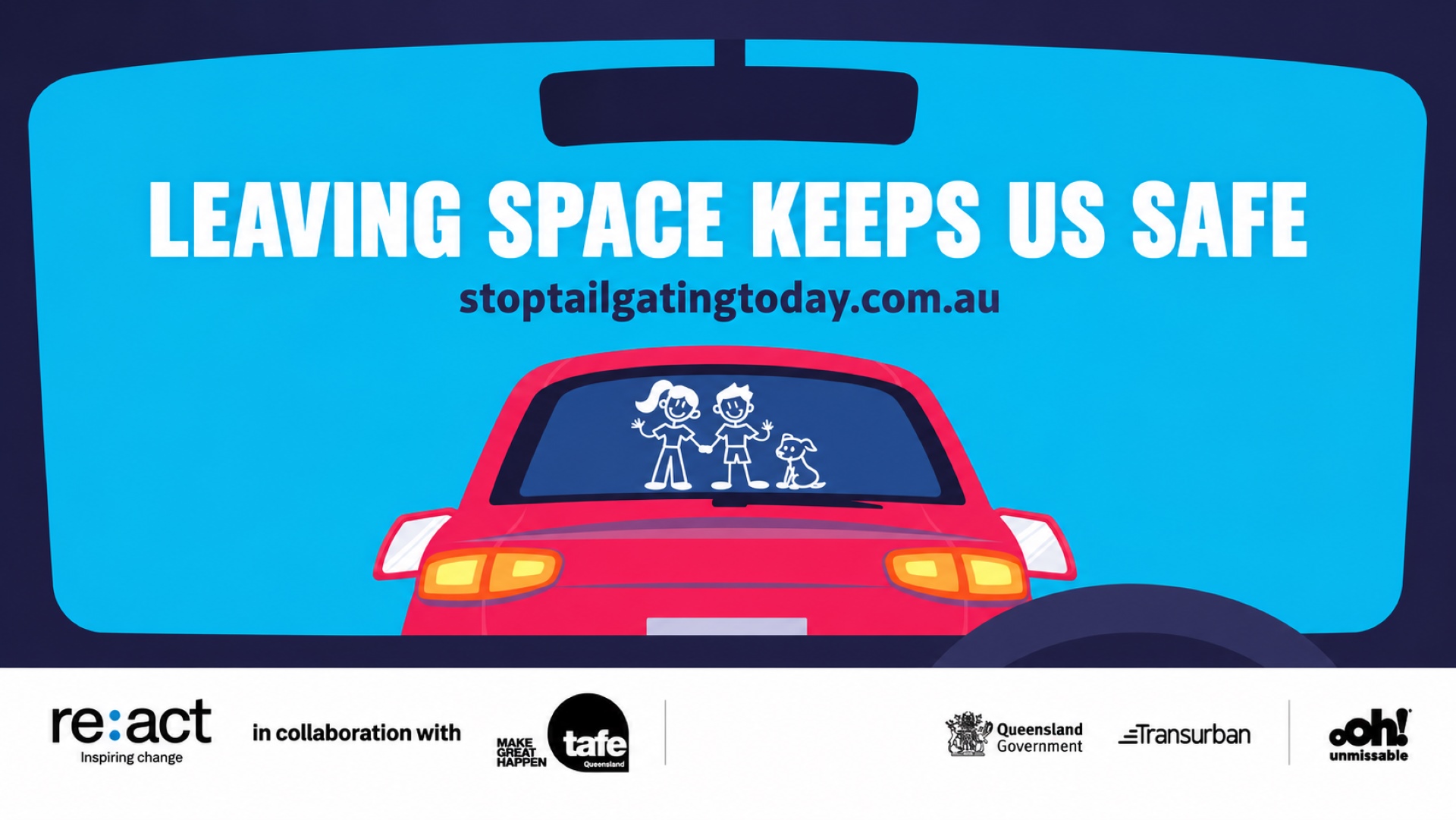
While the students are yet to track down their billboard placement in person, seeing their work move from a classroom project to a public campaign has been a significant achievement.
“This project reminded me that there’s more to graphic design than just creating something beautiful. Designers must also create solutions that make an impact,” continued Jana.
The students said they were particularly excited by the possibility that their work could influence how people behave behind the wheel.
“It honestly makes me really happy that we’re able to have an impact on other people potentially,” Nora said.
Winning wasn't necessarily what motivated the students when they began the project.
Nora recalled that the project also provided them with an opportunity to apply the design process and industry-standard tools they had developed through their TAFE Queensland studies.
The students credited their electronic visual diary (EVD) with helping guide their research and design process. At the same time, access to industry-standard software and facilities allowed them to bring their concept to life.
“I think the EVD was the most helpful of all because they guided us through the research, what we needed to research on, and the process,” Jana said.
Jamila said that their teachers' support was equally important.
“I found that all our teachers are amazingly helpful with our learning, because if we were ever stuck on anything, we can really trust them and rely on them to help us out with it.”
She also highlighted the importance of having access to professional design equipment and software.
“Having access to industry-standard software and computers is essential for these types of projects, because without that, we wouldn’t have been able to do this project at all,” she said.
For Jana, Nora and Jamila, the Re:act project demonstrates how graphic design can extend well beyond creating visually appealing work – and how student projects can have a genuine impact in the community.