


The TAFE Centre of Excellence Health Care and Support is focused on retaining and increasing the number of skilled health, nursing and community services workers, by developing targeted training solutions to build national expertise, including in regional, rural, remote and First Nations communities.
Through collaborative partnerships, the Centre is exploring, developing and piloting higher-level pathways and innovative education and training opportunities to address critical skill gaps.
As part of this commitment, the Centre is funding Applied Research Grants to improve education and training outcomes and help solve industry-identified challenges.
The TAFE Centre of Excellence Health Care and Support is a joint initiative between the Australian Government and the Queensland Government.
Contact the Centre today or subscribe to our newsletter to learn more about partnership, research or pilot opportunities.
Industry-identified priorities and projects
Following industry consultation, the Centre is focusing its research, education and training efforts on the five priority areas. Through collaborative projects across the health care and support sector, the Centre is addressing key workforce challenges and developing practical, evidence-based resources that can be adapted across regions and adopted nationally. These initiatives support workforce capability and retention, improve the quality and consistency of care services, and create valuable opportunities for researchers, students, industry partners and people with lived experience.

Advanced Diploma Community Sector Management Workplace Leadership Program
To help address critical skills shortages across the health, nursing and community services sectors, the Centre is piloting a fully funded Advanced Diploma of Community Sector Management, giving existing workers the opportunity to develop the leadership and management skills needed to progress into frontline and middle management roles across community, health and not-for-profit organisations.
Delivered through a workplace-integrated model, the qualification combines practical learning, mentorship and real-world experience, enabling participants to apply new skills directly in the workplace. Designed for both emerging and experienced leaders, the program builds expertise in service planning, people and performance management, risk oversight and continuous improvement, strengthening leadership capability, career progression and workforce capacity across the health care and support sectors.
Leadership Pathways for the Rural and Regional Disability Support Workforce
Wide Bay Advocacy Inc, in partnership with Ability Works, Bridge 4 Better, IMPACT Community, Carinbundi and CQUniversity, has been awarded a grant to pilot a flexible leadership development program for emerging and mid-level leaders in rural and regional disability services. The project aims to strengthen leadership capability, address career pathway gaps, and support a more confident and sustainable disability support workforce.
The research addresses the challenges faced by team leaders and new managers who often move into supervisory roles without access to leadership training tailored to the disability sector's complex regulatory and operational environment. It also responds to barriers to further study, such as cost, time and workload, by providing a more accessible pathway for developing leadership and management skills.

Dementia Capability Development Program
This pilot delivered in partnership with Dementia Australia, as the national peak body, aims to strengthen workforce capability in dementia care. With a focus on upskilling VET educators to improve the quality and consistency of dementia education across the sector using virtual reality experiences and online learning resources. The pilot is development a suite of online learning modules which provide opportunities for educators to develop their dementia capability. The pilot is developing a suite of accredited units and non-accredited online learning modules which provide opportunities for educators to earn Continuing Professional Development (CPD) points. Click here to read more.
A Day in the Life of a Worker in Home Care
This pilot project is designed to complement and strengthen the core qualification (Certificate III in Individual Support) by providing immersive, practice-based learning experiences, not always achievable in traditional classroom or placement settings. It comprises a suite of 8 virtual reality scenarios designed and scripted in consultation with industry and cultural advisors, where learners actively make decisions, observe consequences, and practice responding to workplace challenges. Students build confidence, apply theoretical knowledge, and safely navigate complex situations prior to entering the workforce.
Community-Embedded Learning Hubs: Enhancing Aged Care Education Access in Regional and Remote Queensland
Ageing Australia has been awarded a grant to pilot community-embedded learning hubs that improve access to aged care training for underrepresented groups in regional Queensland.
The research addresses the need for stronger education and workforce pathways for learners in Far North Queensland, including young people, mature-age learners, First Nations peoples, and culturally and linguistically diverse communities. Through the delivery of Community-Embedded Learning Hubs, the project aims to support workforce participation and transition into the aged care sector.
Inspire & Thrive: Care Workforce Elevation Program
Australian Catholic University has been awarded a grant to deliver flexible training for new aged care workers, with the aim of improving care quality, workforce retention and resilience, and informing future workforce development strategies.
The research addresses the challenge of engaging a time-poor and geographically dispersed aged care workforce in training. It will examine how different delivery modes, including in-person workshops, facilitated online sessions and self-paced learning, influence the adoption and sustainability of person-centred care practices. Read more about the Inspire & Thrive project.
Positioning VET Work Readiness to Support Young Children with Disability/Developmental Delay Within Thriving Kids Reforms
The University of Queensland, in partnership with BUSHKids, Down Syndrome Australia and TAFE Queensland, has been awarded a grant to strengthen learner and educator capability across disability and early childhood qualifications in alignment with emerging Thriving Kids reforms. The project aims to improve support for young children with disability or developmental delay while enhancing work readiness across the care sector.
The research addresses gaps in pre-service education related to the use of technology-enabled tools in disability support, including digital platforms, documentation systems, devices and assistive technologies. By building digital capability and supporting the integration of technology into everyday practice, the project aims to improve service quality, safety and outcomes for children and families.
Enhancing work readiness for complex behaviour support: piloting a lived-experience training intervention
Griffith University, in partnership with the Queensland Disability Research Network – Inclusive Futures Beacon, TAFE Queensland and The Inclusion Network, has been awarded a grant to co-design training that strengthens workers’ capability to support people with disability who experience complex and challenging behaviours. The project aims to promote safer, person-centred service delivery through respectful communication and trusting relationships.
The research addresses gaps in the preparedness of newly trained disability support workers, whose entry-level training often prioritises regulatory requirements over person-centred practice. By incorporating lived experience perspectives, the project aims to improve worker confidence, safety, and the quality of support provided to people with disability.

Practising the Hard Conversations: Conversational AI for Disability Support Workforce Training
Adelaide University, in partnership with the National Centre of Excellence in Intellectual Disability Health and TAFE Queensland, has been awarded a grant to develop a co-designed, browser-based AI tool that enables disability support students to practise challenging conversations in realistic simulated environments before placement. The project aims to build work readiness, confidence and digital capability while supporting improved client outcomes.
The research addresses gaps in students' preparedness for situations such as de-escalating distress, responding to challenging behaviours, and communicating with people who have limited verbal expression. By providing a safe, repeatable environment to practise these skills through interactions with an AI-simulated client, the project aims to strengthen person-centred communication and behavioural support capabilities before students enter the workplace.
Empowering the aged care workforce through leadership storytelling, inclusion pathways, and digital media innovation
Veri Health Media has been awarded a grant to develop culturally safe and inclusive videos and podcasts that address burnout, digital literacy, and the underrepresentation of priority groups in aged care leadership. The resources will be trialled in aged care and vocational education and training settings in regional Queensland.
The research draws on the lived experiences of aged care workers to create digital content that supports workforce wellbeing, strengthens digital capability, and promotes more inclusive leadership pathways across the sector.

“Your Voice, Your Journey, Your Future” - Campfire Healing Mentorship Program (Adv Dip Community Sector Management)
A core component of the pilot of the fully funded Advanced Diploma of Community Sector Management, Campfire Healing has designed, developed and is delivering a Mentoring Program that is culturally responsive, inclusive and meeting established requirements to support emerging leaders within the Health Care and Support sector, including Aboriginal and Torres Strait Islander participants, who are enrolled in the Advanced Diploma program.
The program supports the leadership development and professional capability of pilot program participants; provides mentoring services that meet recognised cultural safety standards for Aboriginal and Torres Strait Islander participants; strengthens leadership capability, wellbeing, confidence and career readiness outcomes, and aligns with TAFE Centre of Excellence Culturally Appropriate and Safe Training Framework and recognised best practice mentoring methodologies.

The CARE-R Project (Cultivating Aged-care Resilience and Engagement in the Regions)
The University of Southern Queensland has been awarded a grant to co-design training and an online platform with aged care providers to strengthen psychosocial safety and resilience among aged care workers.
The research addresses psychosocial hazards faced by the regional aged care workforce and the challenges of accessing training in rural and remote areas. Through the development of an open-access digital platform co-designed with aged care staff and community stakeholders, the project aims to support worker wellbeing, prevent workplace injury, and improve access to mental health resources and training.
Pilot study into the potential of plain language intervention to increase comprehension of safe practices
The Trustee for the Social Deck Trust, in partnership with TAFE Queensland, has been awarded a grant to develop and test plain language communication tools that help disability support workers recognise and report safety risks, understand safe work practices, and support worker wellbeing.
The research focuses on workers from culturally and linguistically diverse backgrounds and those with low English literacy. It aims to improve understanding of safety information, rights, responsibilities and workplace practices, increasing the likelihood that safety issues are identified, reported and addressed.

Making a difference
Our Centre is funding more than $5 million in collaborative Applied Research Grants to support training, learning outcomes and workforce development across aged care, disability support services, allied health, mental health and nursing.
The Grants enhance the capacity and contribution of vocational education and training within Australia’s research landscape, funding innovative and practical solutions that address industry-identified challenges.
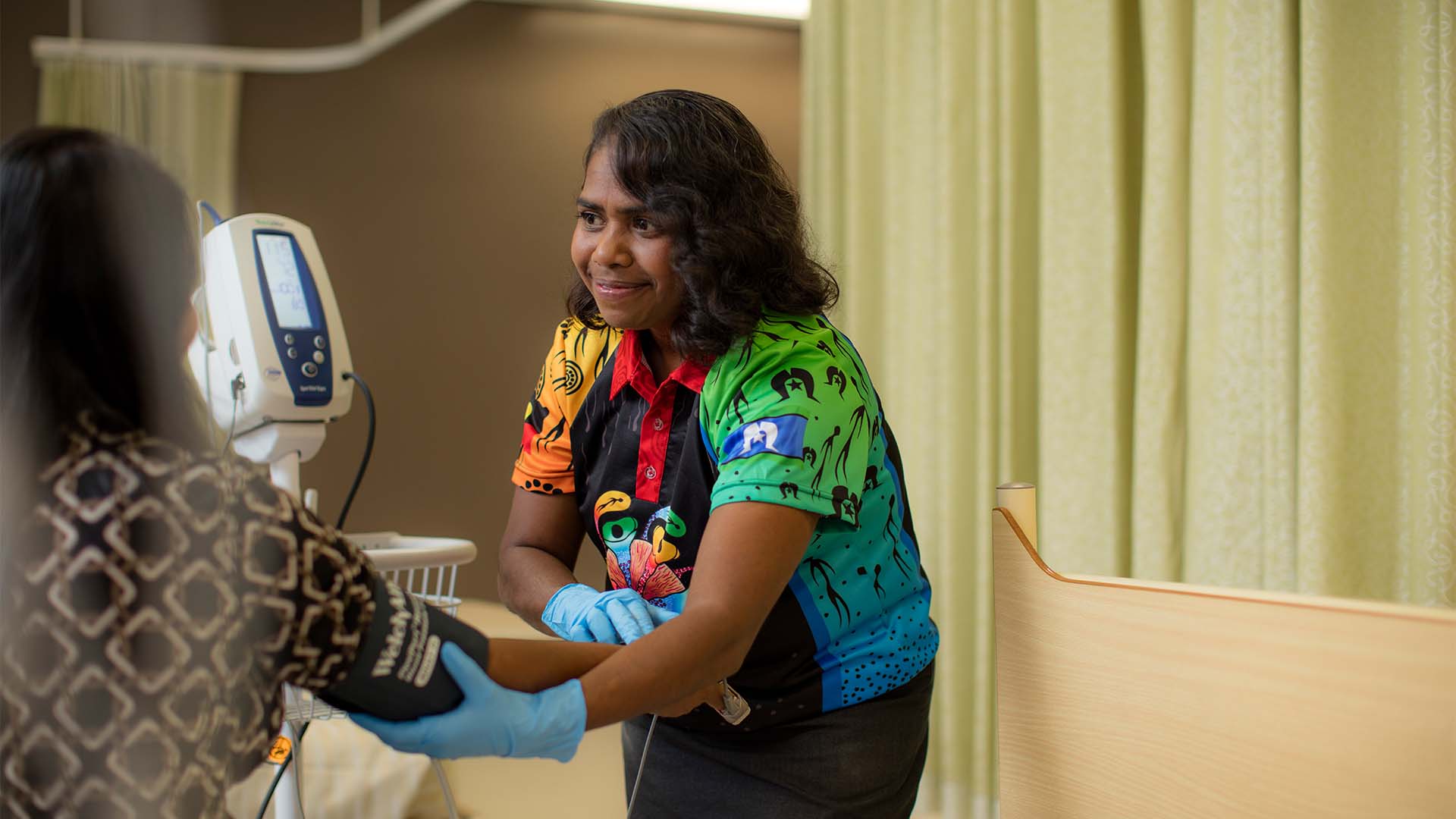
Study with TAFE Queensland
Search TAFE Queensland's health, nursing or community services courses to learn from industry experts and gain hands-on skills to pursue an in-demand career. When you study a health, nursing or community services course with TAFE Queensland you'll have access to purpose-built training facilities, experienced teachers, and vocational placement opportunities.
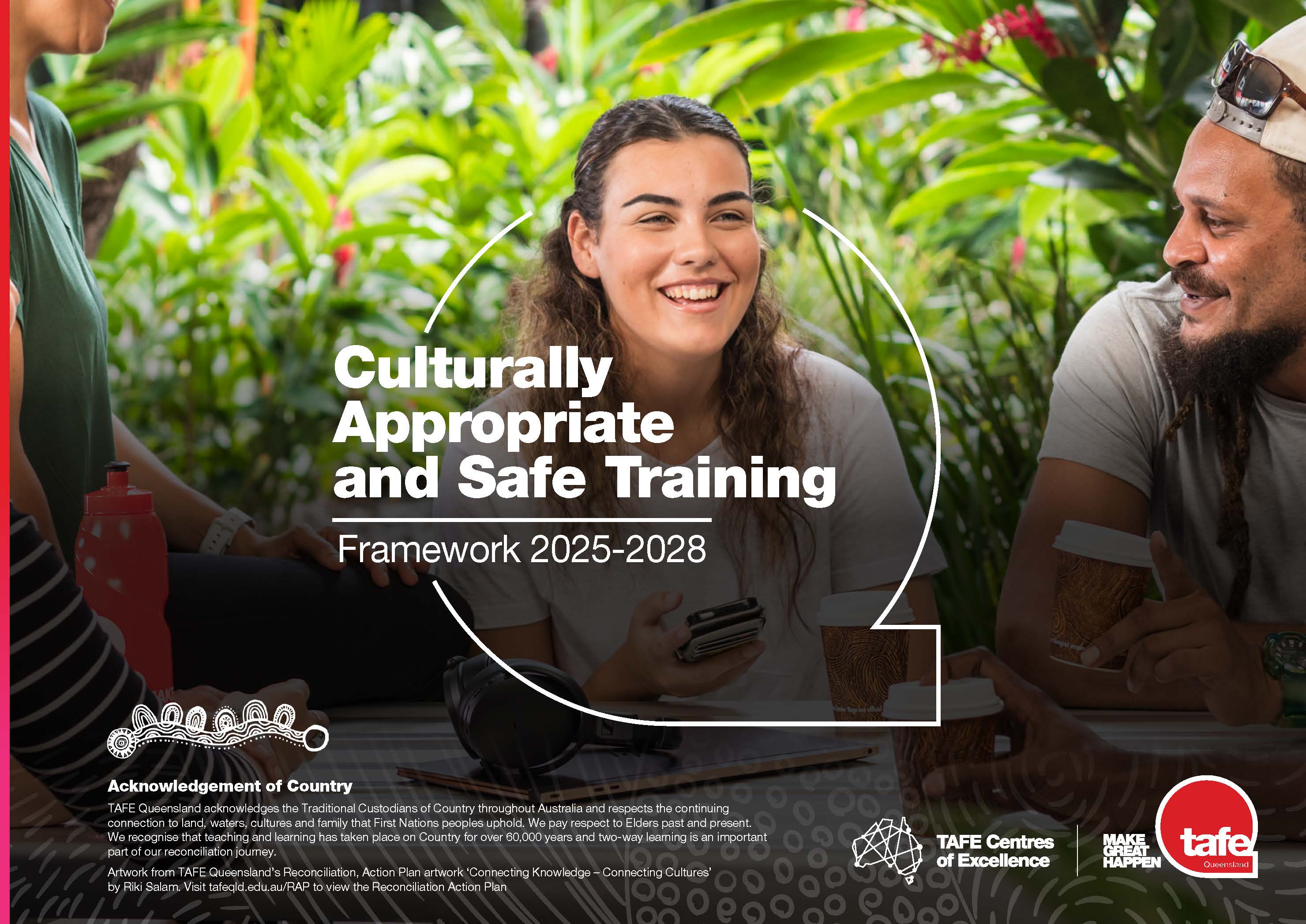
Inclusive education
Designed in close consultation with Community, download our Culturally Appropriate and Safe Training Framework 2025-2028 to learn more about our commitment to create a learning environment that is spiritually, socially, emotionally, and physically safe for Aboriginal and Torres Strait Islander peoples.
Frequently asked questions
Through the National Skills Agreement, the Commonwealth Government is partnering with states and territories to establish TAFE Centres of Excellence. The Australian Government is investing up to $325 million over five years across Australia, with matched funding from states and territories, to establish nationally networked TAFE Centres of Excellence. TAFE Centres of Excellence aim to deliver a skilled workforce for strategically important industries to meet national challenges. TAFE Centres of Excellence will increase collaboration between TAFEs, through partnerships with employers, unions, universities and other stakeholders, and deliver the skills people need for good, secure work and careers.
The initiative aims to grow and retain critical health and support sector workforces, researching and delivering innovative and targeted training solutions. It will build expertise in regional, rural, remote access and delivery, and include industry and community-led applied research through projects that respond to training, workforce and skills needs.
Rather than a single piece of infrastructure, the TAFE Centre of Excellence Health Care and Support instead refers to a network of partnerships, activities and deliverables to address place-based workforce needs and respond to challenges in the health care and support industry.
The TAFE Centre of Excellence Health Care and Support will operate statewide across multiple locations, with the TAFE Queensland Cairns campus serving as a regional hub. The Cairns campus offers expertise, partnerships and community connections to support the TAFE Centre of Excellence Health Care and Support’s focus on supporting health and care skills solutions for rural, regional and remote communities.
A Steering Committee has been established to provide strategic oversight and guidance to the TAFE Centre of Excellence Health Care and Support, with representatives from government, industry and education. The Steering Committee membership is reviewed annually.
Steering Committee members
- Jenni Butler (Chair) - Chief Academic Officer, TAFE Queensland
- Michelle Csapo - Executive Director for Training Products, HumanAbility
- Andrew Hayward - Head of Workforce Strategy, Ageing Australia
- Jackie Ingram - Deputy Director-General, Strategy, Queensland Government Department of Trade, Employment and Training
- Vicky Meyer - General Manager, CheckUP
- Adam Stephen - Workforce and Development Manager, Queensland Aboriginal and Islander Health Council
- Mairi Thomson - Senior Director, Queensland Health
- Loretta Williams - Deputy Dean VET, School of Nursing, Midwifery and Social Science, CQUniversity
Connect with us
TAFE Queensland is collaborating with health care and battery industry experts and organisations to develop a network of national leadership in the delivery of skills, education and training through the TAFE Centres of Excellence. Get in touch with us to get involved and stay updated.
Subscribe now to receive newsletters and regular updates from our Centres.